

In today’s update, we are going over the CalPERS’ investment performance for the FYE 06/30/2026 and how you can estimate its impact on your agency’s unfunded pension liability.
On July 13, 2026, the California Public Employees’ Retirement System (CalPERS) announced a preliminary 14.8% investment return for FY 2026. With the third year of strong performance, this is welcome news for many public agencies.
As a reminder, investment performance exceeding CalPERS’ 6.8% target (also known as the discount rate) helps reduce your agency’s unfunded accrued liability (UAL).
The 14.8% investment return for FY 2026 translates into 8.0% of excess earnings over the 6.8% discount rate. This helps lower UAL balances and reduce UAL payments for California public employers. Official impacts will be reflected in the FY 2026 actuarial reports, to be published in summer of 2027.
The 30-year history of CalPERS investment returns is shown in the graph below.
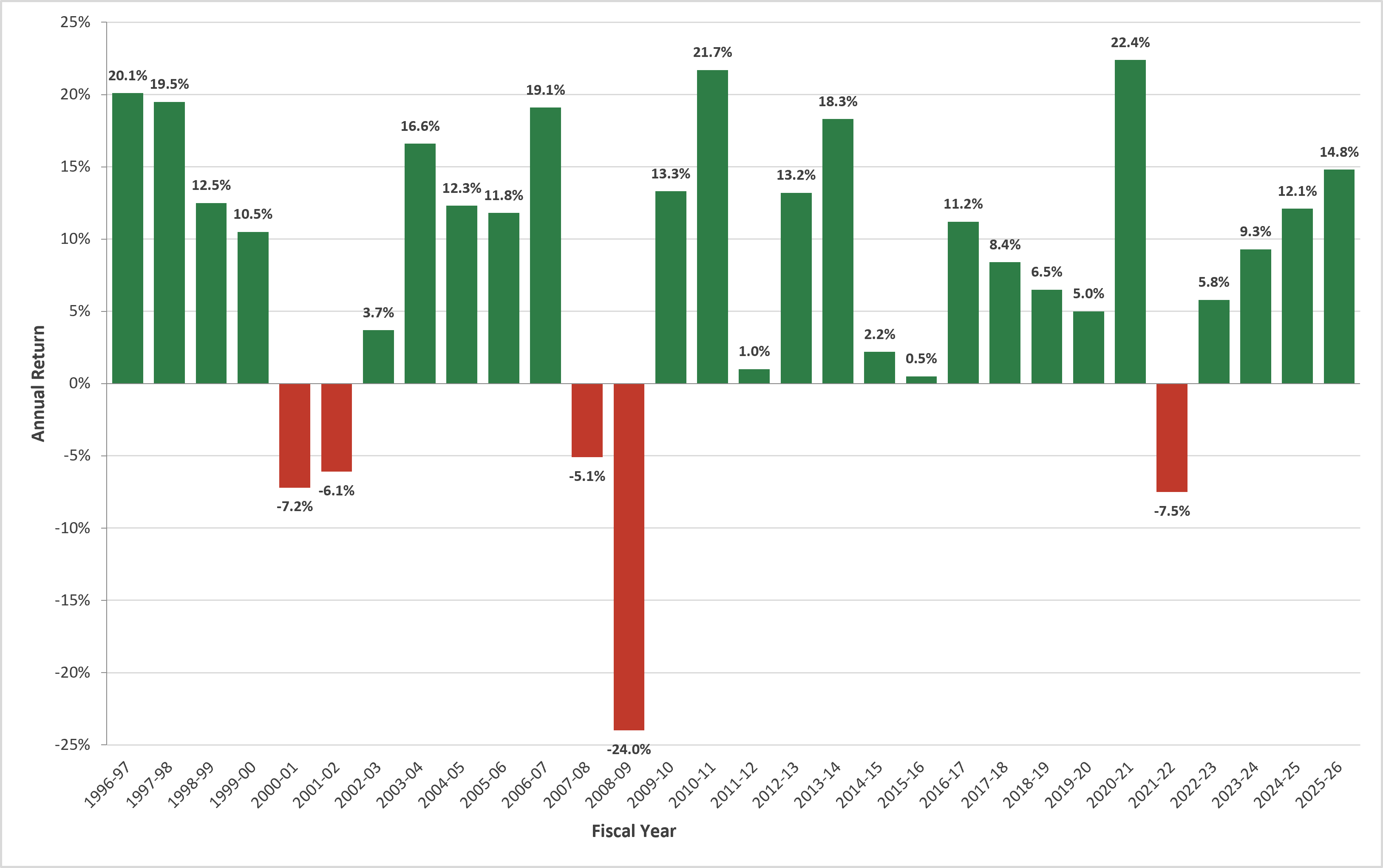
With FY 2026 investment return exceeding the 6.8% target, the pension system’s funded status increased from approximately 79% to 85%. Funded status has not been this high since FYE 2008, just before the Great Recession decimated the pension system.
This performance was driven by strong gains in public equities (24.1%), private equity (17.0%), and private debt (11.0%). Fixed income delivered a solid 5.9% return, while real assets posted a modest 6.3% gain. It should be noted that returns from private equity, private debt, and real assets typically lag by a quarter and remain subject to future adjustments.
To quantify what the 14.8% investment return means for your agency, it is important to understand CalPERS’ funding math.
To estimate the FY 2026 excess return impact on your agency’s UAL, you can multiply the market value of assets within your pension plan by the 8.0% excess earnings. This will be the approximate amount by which the UAL is reduced.
For each $1 million in pension plan assets, roughly $80,000 of existing UAL will be removed from each agency’s account.
The lower UAL balances will first be reflected in the 2026 actuarial reports, which CalPERS will publish in July/August of 2027.
The FY 2026 performance will result in higher funded status of pension plans, lower UAL balances, and lower future UAL payments, as the effect of the excess earnings will be spread over the next two decades. There should be no change to the Normal Cost contribution rates due to the investment performance.
The impacts of the FY 2026 investment performance are illustrated below:

If CalPERS continues to follow its current amortization practices, the FY 2026 UAL reduction will be phased-in over a 20-year period starting with FY 2029, with a five-year credit ramp-up:
With three years of strong investment returns and the associated UAL reductions, many agencies are likely to see a shortening of their total UAL amortization period, as the FY 2026 excess return credit is likely to extend beyond the current UAL repayment schedule.
Years with excess returns should be allowed to work in your agency’s favor. Unlike UAL increases, which create negative amortization, unamortized UAL credits create additional investment income for your agency's pension account. Thus, maintaining the ramp-up structure for credits can help maximize long-term benefits.
In November 2025, CalPERS elected to keep its discount rate at 6.8% level. Additionally, the automatic discount rate reductions in years with excess investment returns remain on pause and are subject to the CalPERS Board review.
CalPERS’ average annual returns currently stand at
These results generally support maintaining the current 6.8% discount rate.
Besides investment-related UAL changes, CalPERS conducts an annual reconciliation comparing the actual plan experience to actuarial assumptions. This analysis will result in additional UAL adjustments for FY 2026, but we will find out about them only in July/August of 2027.
Ridgeline Municipal Strategies, LLC can help you evaluate the impacts of the FY 2026 investment performance on your pension costs, make sense of the actuarial report format, and implement appropriate pension cost optimization and mitigation strategies.

Ridgeline's assessment of CalPERS' FY2024 investment performance and its impact on the CalPERS member agencies.
Read this post.webp)
Fire station and apparatus financing is complex. Here we explore the 8 most common financing mistakes made by fire departments.
Read this post
Fire mitigation fees help fire departments get funding for new facilities and apparatus. Ridgeline’s best practices guide shows how to plan, implement, and manage fire mitigation fees for maximum impact.
Read this post
Ridgeline served as a municipal advisor on the issuance of the $10,925,000 Water Revenue Certificates of Participation with $12,000,000 in proceeds for the Tehachapi-Cummings County Water District.
Read this post